Lai Should First Talk with Beijing for Dialogue on Taiwan
By Shih Wei-chuan, China Times Opinion, December 01, 2025
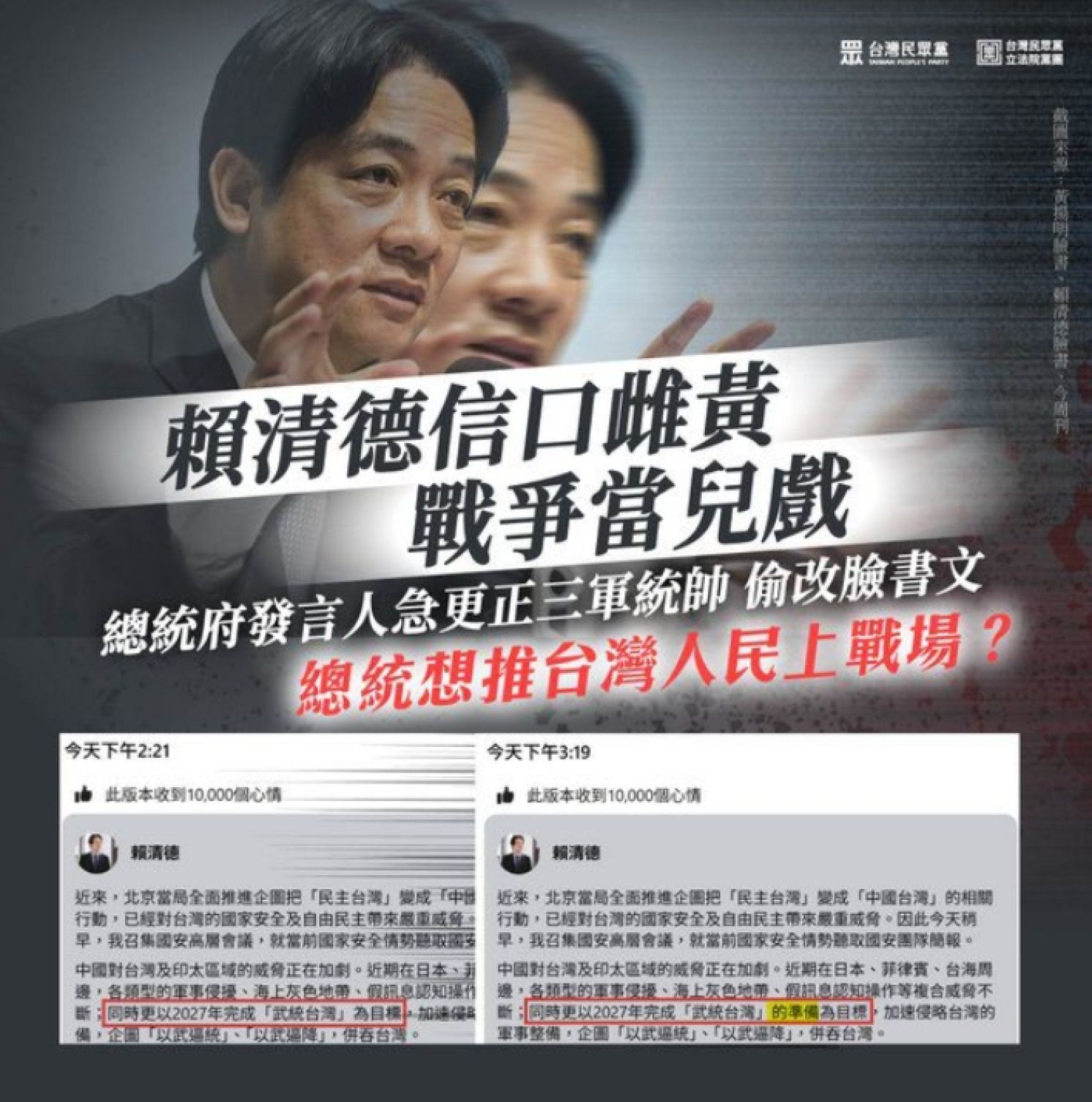
Did Beijing plan to take Taiwan by force in 2027? President Lai Ching-te has offered three different versions. The official video version shows him saying that “the Beijing authorities also aim to ‘unify Taiwan by force’ by 2027,” and the transcript the Office of the President sent to the media is the same. Later, however, the version published on the Office of the President website reads: “the Beijing authorities also aim to complete the preparations for ‘unifying Taiwan by force’ by 2027.” Adding the three words “the preparations for” makes a significant difference.
The 2027 invasion claim is a misconception spread through public discourse, originating in U.S. narratives before circulating to Taiwan. In 2021, Admiral Philip Davidson, then head of the U.S. Indo-Pacific Command, made similar comments in congressional testimony. His successors repeated in 2024 that 2027 is a conditional invasion year. In 2023, then-CIA Director William Burns echoed this view.
When American officials discuss 2027, their emphasis is on China acquiring the capability to invade Taiwan—an assessment based on Chinese President Xi Jinping’s directives to the People’s Liberation Army (PLA), which is public information rather than classified intelligence. On the question of 2027, American officials stress that this refers to a state of readiness, not a fixed invasion date. “Unification by force” is not established policy, let alone a predetermined date such as 2027. The wording published on the Office of the President website is clearly more precise and obviously intended to correct the earlier mistakes, demonstrating that President Lai misspoke.
Was President Lai’s misstatement intentional? Was he attempting to mimic former U.S. President Joe Biden’s pattern of deliberate “misspeaking”? On four occasions when asked whether the United States would send troops if conflict broke out across the Taiwan Strait, Mr. Biden responded affirmatively, after which the White House or State Department issued clarifications. Mr. Biden and his aides played a two-step routine with two key features: First, it always occurred when Mr. Biden was reacting passively to reporters or members of the public—he needed to project toughness. Second, the issues he addressed were American policies that he could reinterpret or shape, not objective facts.
Objective facts cannot be used as material for political theatre, especially in settings intended for policy statements; otherwise, subsequent corrections simply embarrass the speaker. President Lai’s blunder was clearly an oversight: his staff drafted an inaccurate script, and President Lai failed to grasp the nuances and implications embedded in the wording used in U.S.–China–Taiwan interactions.
President Lai’s reference to 2027 was intended to justify increasing defense spending. His remarks were made after a high-level national security meeting. As usual, the meeting outlined interagency national security measures and addressed developments in the Asia-Pacific following several recent interactions between the United States and China.
President Donald Trump of the United States and Mr. Xi had just concluded their Busan summit, during which Mr. Trump emphasized that the two did not discuss Taiwan. Later, Mr. Trump personally called Mr. Xi. In Beijing’s readout, China stressed that “Taiwan’s return to China is an important part of the post-war international order,” and noted that the United States “understands” this position. The summit did not touch on Taiwan because the issue no longer requires the highest level of bilateral engagement; the follow-up phone call did reference Taiwan because Beijing sought to highlight its seriousness in response to Japanese Prime Minister Sanae Takaichi’s earlier remarks, pressing Washington to take note.
What is most noteworthy is that in discussing the Trump–Xi call, each side highlighted different points. They spoke past each other without contradicting the other’s statement, and the only concrete overlap concerned Ukraine—a matter Mr. Trump urgently needed progress. Before taking office, he had already claimed that he would secure a Russia–Ukraine ceasefire on his second day in office. He is eager to deliver a new framework for peace.
As shown by the recent United Nations General Assembly vote, both Russia and China abstained, allowing the U.S.-led proposal to pass—an outcome that reflects U.S.–China bargaining and compromise. In the current global environment, the United States needs Beijing’s cooperation. Regarding Ms. Takaichi’s remarks, Beijing considers Taiwan purely a domestic matter and rejects any U.S.–China co-management of the issue. But after Mr. Trump called Mr. Xi, he immediately called Ms. Takaichi, urging Japan to tone things down. Ms. Takaichi later “substantively adjusted” her remarks during Diet questioning. From Beijing’s perspective, this illustrates U.S.–China coordination effectively managing uncertainties in international affairs.
Under U.S.–China choreography, Taiwan is being marginalized and is losing leverage over its own fate. This predicament cannot be reversed through a handful of policy announcements at a national security meeting; it requires a comprehensive strategic recalibration. Taiwan’s objective should be to participate proactively in U.S.–China dialogue concerning the Taiwan issue. The starting point must be that Taiwan speaks with Beijing—and also with Washington. Unless the Democratic Progressive Party (DPP) adjusts its mainland policy, Taiwan will remain unable to take part in the international conversations that determine its own future.
(The author is adjunct assistant professor in the English-taught political economy program at Tamkang University.)
From: https://www.chinatimes.com/opinion/20251201003806-262104?chdtv